
Nondestructive Imaging and Quantification of Composition in 2D MoS2 and V-Doped MoS2 by the Auger Scatterplot Method
Ľubomír Vančo, Ravi K. Biroju, Mário Kotlár, Viliam Vretenár, Dipak Maity Tharangattu N. Narayanan
In: J. Phys. Chem. C 2025, 129, 47, 20995–21004
https://doi.org/10.1021/acs.jpcc.5c05299
Abstract
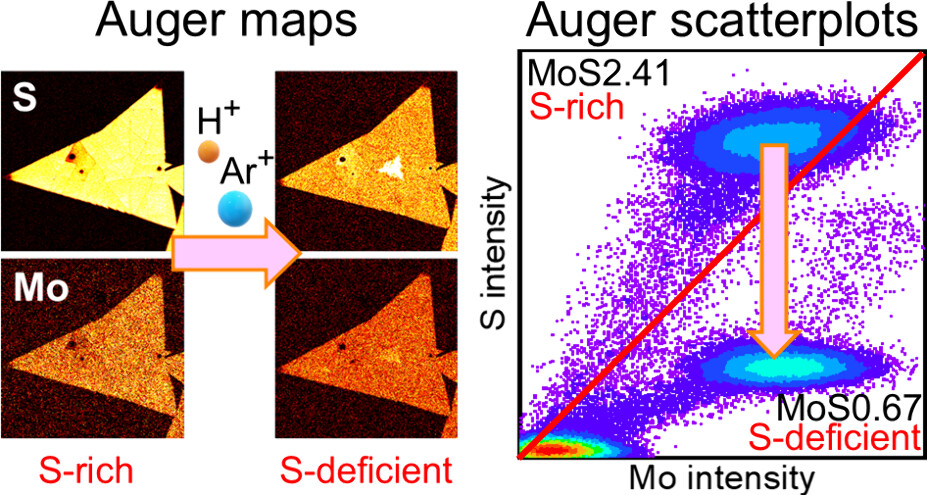
Molybdenum disulfide (MoS2) monolayers have emerged as promising materials for a variety of applications. Their behavior depends critically on surface composition; therefore, careful characterization is necessary to describe their properties accurately. Although Auger electron spectroscopy (AES) is a standard method capable of addressing this issue, it suffers from beam-induced damage and variation of spectral features in complex samples. To overcome these limitations, we employed correlative analysis to examine MoS2 and V-doped MoS2 2D surfaces by using Auger scatterplots. As we demonstrate, this method enables the nondestructive imaging and assessment of the lateral and depth distributions of the elements and provides a remarkably convenient way to estimate S-rich/depleted regions. The scatterplot technique indicates that V doping in MoS2 retards desulfurization in an Ar/H2 plasma environment. By reducing the electron dose, the analysis using scatterplots can improve the accuracy of AES by up to 30%. The Auger scatterplot method provides insight into the affinity or independence of surface constituents through quantitative relationships, enabling separate analysis of the characteristic areas within a complex sample. These findings are supported by Raman spectroscopy and transmission electron microscopy, which highlight the effectiveness of the Auger scatterplots and their potential for examining the surfaces of 2D materials. Auger maps also show a strong correlation with photoluminescence features in MoS2 monolayers, thereby illustrating the overlap with practical applications.