

PROJEKT
Augerova elektrónová spektroskopia pre štúdium povrchov dvojdimenzionálnych MoS2 vrstiev
ABSTRAKT
V posledných desaťročiach sa venovalo veľké úsilie výskumu rôznych 2D vrstiev vrátane MoS2. Ich aplikovateľnosť na široké spektrum problémov vrátane environmentálnych a klimatických otázok stále priťahuje vedcov v rôznych oblastiach. Ale vzhľadom na technologické výzvy spojené s výrobou čistejších 2D povrchov sa ich aplikačný potenciál zatiaľ nenaplnil. Cieľom projektu je zistiť, ako znečistenie povrchu ovplyvňuje zloženie nesených a suspendovaných dvojdimenzionálnych vrstiev MoS2 a ako sa mení s aplikovanými dolešťovacími postupmi. Ako nástroj na štúdium bude použitá Augerova elektrónová spektroskopia (AES), ktorá sa ukazuje ako výborná analytická metóda pre 2D vrstvy, schopná odpovedať na otázky lokálneho zloženia povrchu, kontaminácie, homogenity a dolešťovania. Skúmať sa bude aj odozva elektrónov v 2D vrstvách MoS2 na primárne elektróny, pričom sa očakávajú zaujímavé efekty, ktoré zatiaľ neboli opísané v metodike AES.
DETAILY PROJEKTU
Kód projektu: 09I03-03-V04-00457
Kód výzvy: 09I03-03-V04 – Štipendiá pre excelentných výskumníkov a výskumníčky R2-R4
Komponent: Komponent 9 – Efektívnejšie riadenie a posilnenie financovania výskumu, vývoja a inovácií
Investícia: Investícia 3 – Excelentná veda
Prijímateľ: Slovenská technická univerzita v Bratislave
Financované: Európska Únia (NextGenerationEU)
Poskytovateľ: Výskumná agentúra
Doba riešenia: 01 September 2024−31 August 2026
PUBLIKÁCIE
Ľubomír Vančo, Ravi K. Biroju, Mário Kotlár, Viliam Vretenár, Dipak Maity, Tharangattu N. Narayanan
Nondestructive Imaging and Quantification of Composition in 2D MoS2 and V-Dpoed MoS2 by the Auger Scatterplot Method
In: J. Phys. Chem. C 2025, 129, 20995−21004, https://doi.org/10.1021/acs.jpcc.5c05299
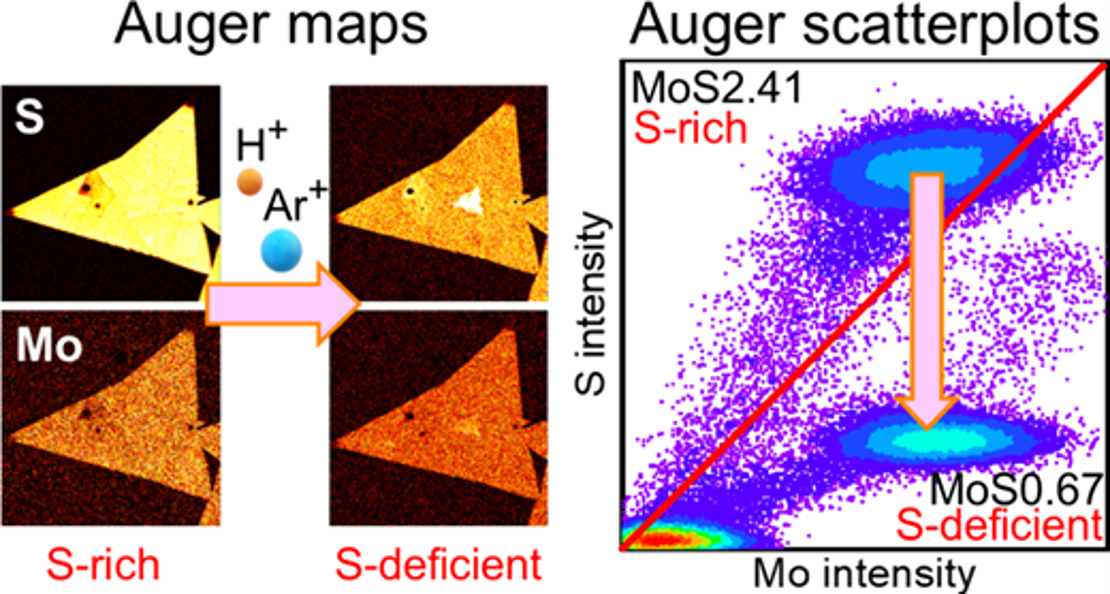
Molybdenum disulfide (MoS2) monolayers have emerged as promising materials for a variety of applications. Their behavior depends critically on surface composition; therefore, careful characterization is necessary to describe their properties accurately. Although Auger electron spectroscopy (AES) is a standard method capable of addressing this issue, it suffers from beam-induced damage and variation of spectral features in complex samples. To overcome these limitations, we employed correlative analysis to examine MoS2 and V-doped MoS2 2D surfaces by using Auger scatterplots. As we demonstrate, this method enables the nondestructive imaging and assessment of the lateral and depth distributions of the elements and provides a remarkably convenient way to estimate S-rich/depleted regions. The scatterplot technique indicates that V doping in MoS2 retards desulfurization in an Ar/H2 plasma environment. By reducing the electron dose, the analysis using scatterplots can improve the accuracy of AES by up to 30%. The Auger scatterplot method provides insight into the affinity or independence of surface constituents through quantitative relationships, enabling separate analysis of the characteristic areas within a complex sample. These findings are supported by Raman spectroscopy and transmission electron microscopy, which highlight the effectiveness of the Auger scatterplots and their potential for examining the surfaces of 2D materials. Auger maps also show a strong correlation with photoluminescence features in MoS2 monolayers, thereby illustrating the overlap with practical applications.
Ďalšie publikácie:
Ľubomír Vančo, Ravi K. Biroju, Mário Kotlár, Viliam Vretenár, Dipak Maity, Tharangattu N. Narayanan: Analysis of two-dimensional molybdenum disulfide layers by scanning Auger microscopy. In: Extended Abstract Book of 14th Conference “Solid State Surfaces and Interfaces” November 18-20, Smolenice, Slovak republic, Comenius University, ISBN 978-80-223-5941-2.
Ľ. Vančo, M. Kotlár, P. Vogrinčič, M. Štrbák, S. Dharmapuri, Determination of thickness in suspended MoS2 layers using backgrounds in Auger electron spectra. In: Proceedings of ADEPT – the International Conference on Advances in Electronic and Photonic Technologies, Nový Smokovec, Slovakia, june 15th – 18th, 2026, EDIS-Publishing Centre of UNIZA, ISBN 978-80-554-2303-6.